Skip to content

The Little Things

“Don’t sweat the little things, and remember that everything is a little thing.”

This advice was doled out by a girlfriend’s mother a long while back, when I was going through a relatively rocky stretch. She wasn’t trying to pass it off as original; she’d heard someone say it on a talk show. The first part is as old as the hills, and the second just a clever addendum that doesn’t really pass close inspection. It’s the type of thing Dr. Phil puts in hardcover every three months to add a new wing to his joint in Palm Beach. On a certain level everything is a little thing. But sometimes the little things are the big things.

I got kicked off the roof of my building twice this weekend by a woman who’d installed a motion detector on her private deck just below. It had never happened before – there’s an official “curfew” posted in the lobby, but no one had ever enforced it, and it was only twenty minutes past this time. What was more distressing, though, was her manner. She was abrupt, authoritative, and unresponsive to my attempts to apologize and better understand why the situation had changed. She even waited behind until I’d left, like a warden at lockdown. I considered confronting her more forcefully, but something in her way made me think that this wasn’t a good idea.

On the surface, this incident falls squarely between the boundaries of the little things. You take people as they come, and let water roll off your back. I’ve been chastised for not letting things go in the past, but I’ve dismissed much larger deals with apt aplomb. Maybe it’s because I’ve really enjoyed that roof. I’ve been thinking of looking for a new place lately – given the shifting economy, I’m probably paying too much rent. But the view from up there is spectacular, and you can see most of Brooklyn, the Statue of Liberty, and all the way to midtown Manhattan. I’ve enjoyed going up there later in the evening, just for a quiet breath of fresh air. All the shit that doesn’t fit together during the day can seem irrelevant in those few minutes, and the world spread out in almost manageable order. Just a little thing.

My buddy Scott who was out here last weekend once noted that “you wouldn’t want to know the real number of people who are just hanging to a thread out there.” The comment stuck with me for some time, and I’d like to think that it caused me to walk a little more gently since. Sometimes it feels like you can just see it in someone’s eyes; like they might fall apart or explode if you make one wrong step in either direction. I don’t figure I’ve been there myself too often, and for this I’m thankful. I’m also thankful for all the great views I’ve had in my life – despite the many blessings I’ve taken for granted, this hasn’t been one.

Of Subways and Sit-Downs

Myers & Miller

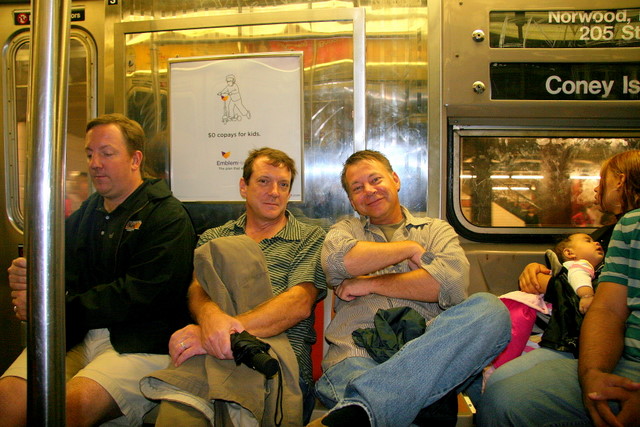
Tom Myers (on the left) and Scott Coleman Miller were visiting me in New York this past week. I often associate one with the other – they were roommates for a while and both worked in the print department at my family’s company. Tom was actually Scott’s boss, though when I point this out he (Tom) acknowledges it only with bemusement. The truth is that they’re more like bookends than they are exact copies, and each offsets the other nicely. Scott leans forward where Tom leans back; Tom defers gracefully while Scott stirs the drink. I’m not sure where I fit in the mix, but I’ve always enjoyed hanging out with both of them. As someone once wisely observed, “you can’t make new old friends.” The poignancy of this sentiment only increases with age.

The weather didn’t treat us well, but this mattered little. We managed to fit in a bit of both Brooklyn and Manhattan, some sausage and peppers heroes, and a good sampling of The Larry Sanders Show. They also got some exposure to my world on this coast, in all of its random glory. There was a time, not so terribly long ago, when I took such fraternizing for granted. It was always there when you wanted it. That this is no longer the case makes it even more valuable, and it was good to see that it can always be picked up just as easily as it was left behind.

Boom, Boom! Boom! Boom! Boom!

The weather broke in New York City yesterday and a two week span of ninety degree days shifted in to something cooler and more palatable. This morning’s light rain and upper sixties temperatures felt like San Francisco – with an added boost of perspective, coming on the heels of everything that a Big Apple August can imply : stagnation, suffocation, and the kind of sweat you scrape off your body with the dull edge of a credit card.

I made a pasta meal Wednesday night for my long-time east coast acquaintance and Boom Operator To The Stars, Kelly. After dinner we went on a short digestion-facilitating walk that blossomed into an eight-mile test of endurance and included the Brooklyn, Manhattan, and Williamsburg bridges, an almost militantly separatist Hasidic neighborhood, and Steiner Studios by the Brooklyn Navy Yard.  Upon reaching the film lot, I queried Kelly as to whether he knew the guard at the front gate, and he responded in his always-caffeinated and nicotine tempered Mickey Rourke baritone “No! But I’m a card-carrying member of Local 52, and rest assured we will be acquainted in short order ..” Kelly has a kettle-drum quality to his vocal accentuation that makes his chosen vocation as boom operator more than appropriate. Sure enough, in no time we were traversing the cavernous, deserted enclave at one in the morning as he barked out a wandering narrative with violent emphasis on particular words: “Studio Six ! That’s where I boomed Flight of the Conchords ! ..”

Though he claimed that it was just an “average night’s walk” for him, and really no different from sitting in front of the TV, by the time we crossed Bushwick Ave he was more than amiable to my offer to buy him a cold drink, and we hoofed it another several miles from there, Gatorade and Lemonade in hand, to the Williamsburg G Train and back to my neighborhood. Kelly’s pointing himself in the direction of California soon, both for film work and a medicinal marijuana card to address some chronic pain issues. ( And, I suspect, to remain consistently and astronomically high. ) He appears and disappears at different points on my horizon, often punctuating some unconscious shift in my own mental and physical landscape.

As the cooler weather marks yet another September transition, my buddies Tom Myers and Scott Miller will be visiting in a few weeks. Scott changed his name to “Coleman” several years back, to better distinguish himself from the legions of Scott Millers out there keeping celluloid relevant in an experimental manner. He celebrated a significant birthday last month, and Tom and I purchased him a Wrigley Field seat back, autographed by the greatest of Cubs, Ernie Banks. Miller seemed appreciative, and noted that the seat came with a “letter of authentication” signed personally by Mr. Cub. “I was thinkin’ about those letters of authentication,” he remarked to me, “and wouldn’t it seem right that they’d come with a letter of authentication themselves? I mean, doesn’t a letter of authentication need a letter of authentication to be worth anything? And where does the cycle end ?”  I didn’t have an answer for him, but the speculation was pure Scott Miller, and nothing that anyone named Coleman could ever come up with.

Don Draper Logic

Mad Men kicked off its third season on AMC last night, and it’s either jumped the proverbial shark or is heading into exciting and uncharted waters, depending on your slant. It’s no Sopranos-grade production and its creator Matthew Weiner is no David Chase, despite the former having worked for the latter on said superior program. Still, I thought it good enough to have the first season shipped to my dad, and he made it through all thirteen episodes in the time it generally takes my mom to figure out how to turn on the VCR. (Again, this is a relative comparison, and the Crimean War was decided in shorter order.) I knew the old man would dig the the early 60s time frame for the show, and find it accurately portrayed and executed. The production’s greatest hooks are largely superficial – everybody smokes like a chimney and is on their third office rye by noon – but it still works. Plus it’s a kick to trip back in time to when white women were allowed to have curves.

There is one intriguing theme running beneath the surface of Mad Men making it worthy of comparison to The Sopranos. Almost everybody on the show has some dark or darkly imagined secret that they’re trying to conceal, and in several cases their cover is compromised when another becomes privileged to this information. Don Draper, the principal character and a dapper, buttoned-down sort who plays things close to the chest has perhaps the most encompassing yet conventional secret of all: he isn’t who he claims to be and has stolen the identity of his dead Korean War lieutenant. One of the shows best moments comes when Pete Campbell, an unctuously ambitious subordinate, tries to blackmail and then ruin Draper by blowing his cover and ratting him out to Bertram Cooper, the head of the ad agency. “Mr. Campbell,” Cooper responds upon hearing the news, “who cares.” Potentially the best written four words in recent television history.

I was considering this “keeping up appearances” theme while thinking about a Steve Buscemi quote from Trees Lounge, a favorite film of mine which he also wrote and directed. Buscemi is doing coke at his uncle’s wake, waxing philosophic with some cousins. “Everybody’s fucked up,” he observes “and nobody wants you to know that they are, but everybody knows it anyway.” Had Buscemi taken this premise and added well-tailored suits, ample booze and four hundred cartons of Lucky Strikes, he may have tripped upon Mad Men. It isn’t the mystery or intrigue that makes Don Draper a watchable character, nor even his insight to the shameful secrets and truths everybody else is harboring. It’s his measured approach to an even more enlightened reality apparently attained by his boss, Bertram Cooper: nobody really gives a shit anyway.

Problem Child

problem childI’m hot
and when I’m not
I’m cold as ice
– Young, Young & Scott

Pervasive summer fog punctuates another longish San Francisco stay, and by trip’s end I find my condition mirroring the area’s meteorological state: low, even, and not letting up any time soon. The flight is always shorter west-east, and thankfully so. A late life first time father sitting across from me takes advantage of his infant son’s only non-screeching in-flight interval to pick the kid up and make raspberry sounds on his forehead. In seconds, Junior is again wailing and I’m about to deck a sexagenarian. But I restrain myself admirably, endure the rest of my air time, and am soon cabbing it home from Kennedy. My place is clean, left so by my landlord who was renting it back for a mid-summer stay. A warm, boxed slice awaits me, the air conditioning is on, and my eyes and brain readjust once more to the readjustment. Except this time the blur hangs a little longer and something in my brain feels funny – even funnier than usual. I chalk it up to geographical ambivalence, renter’s instability, barometric fluctuation, Eastern Daylight Time and thoughts of loved ones. Chalk it up to too many things to chalk it up to.

Wednesday rolls in – high eighties, sweaty and charcoal dark by mid afternoon. Foreboding skies eclipse threatening to the point of no return. An uneasy, day-long pressure builds inside of me and lodges in my chest with each held breath like a thumb over a cranked garden hose. A few large splatters of rain hit the window and a cold blue chunk of forked lighting touches down only blocks away, so close that I hear its throbbing, charged electric buzz a half second before a slam of punishing thunder sets off a half dozen car alarms. Soon the water is slashing down in vertical sheets, hard enough to pull leaves from branches and stinging the paved street on contact. As I observe, something inside of me adjusts accordingly and the thumb pops off the nozzle.

Friday night I’m waiting in an exceptionally long line at Penn Station, hundreds winding back from a ticket machine spitting passes for a new rail line to Jersey. There’s at least a dozen equally long lines twisting and stemming from identical machines, and I figure I’m screwed – won’t be getting to where I’m going ’til midnight. But things tend to move faster in this city, and people generally know what they’re doing when they get there. I make remarkable time to the front of the line and purchase a ticket to Secaucus where I and most of these folks will catch an adjunct rail to the Meadowlands and Giants Stadium. I’ve received birthday tickets for hard rocking, boogie-woogie madmen AC-DC, and seeing them here is akin to some sort of last chance rite of passage. Sure, I’m too old for this shit, but the irrelevance of this observation is staggering. I find myself shoulder to shoulder in a passenger car with an equal number of fans both twenty years my senior and junior. “Ladies and Gentleman,” the conductor’s voice cracks over speaker, tongue planted firmly in cheek, “welcome to the AC-DC rock ‘n’ roll train ..” Mayhem.

It’s ten pm, skies have parted and rain stopped, and there’s Angus Young, all fifty-four years and five foot one inches of him, selling it in his schoolboy uniform like there’s no tomorrow; jerking and kicking around the massive stage and hundred yard catwalk like an epileptic Red Bull pitchman on an especially jittery day. The young couple in front of me are ecstatic – he bolting for the aisle to join a Jersey muffler shop day worker, playing Beavis to the older dude’s Butthead with horned fingers thrust and heads thrashing in crazed syncopation to an anchored, driving backbeat. She hangs back above their seats, dancing purposefully and fluidly with her beautiful self, a pole-less untouchable stripper shattering the adage that youth is wasted on the young. And it occurs to me, the thing about this band – they’ve never taken themselves too seriously. The show rages on with relentless pace amid a stage decked with two huge, horned, inflatable schoolboy hats with capital “A’s” up front. A massive, wrecked, still-smoking locomotive protrudes above the drum kit, the numerals 666 across its nose. Hell has never been some serious, spooky metalhead stance for these dudes; just a metaphor for no tomorrow. Fireworks explode in rapid-fire succession after the midnight encore, spectacularly anticlimactic when held next to what Angus has left on stage: four gallons of sweat, two pints of blood, and every bit of himself. Rarely does one feel so compensated, putting down twenty-nine fifty on a ticket. House lights come on and a thick cloud of smoke hangs over the Jersey night. Another New York day ends.

Mean Streets of Marin

I park my car on Bon Air, alongside Marin General and cross light traffic to the bike path by the Corte Madera Creek. It’s the same path I’d pedal to Kent School every morning in the seventh grade, and as I break in to a  jog, visions return. There’s the twelve year-old Bruce Strahmborne (not his real name) on the path – an odd kid who kept a “thing box” filled with rusty nails and plastic buttons. He was always getting picked on, and this particular day is no different. The Sommerfield twins, Randy and Bill, have him boxed in on either side of his bike. They position their front tires each time Bruce makes an attempt to escape until finally, out of panic and frustration, he pulls a tiny penknife – one and a half inch blade barely suitable for opening a loosely-sealed letter – from his backpack. “He’s got a knife!” Randy Sommerfield exclaims, as he and Bill pedal off furiously. “What a maniac!”

Other more legitimately disturbing incidents would helped cement Bruce’s reputation, and whenever something like this occurred it enhanced his legend. Within hours the penknife was a switchblade, slashed wildly at both brothers and narrowly missing an ear. They were bad news, the twins, and forever scouting easy prey.  I  had a run-in with Randy. He hit me in the arm after a ceramics class to see how I’d respond. Through quick calculation I returned the favor, as hard as I could, and that was it. He rubbed his arm for a while and moved on to consider other targets. The rule would apply to all bullies well in to adulthood. Those hitting hardest were the same ones hiding in their homes, fearing being revealed.

I pick up the pace, marshland air from the creek in my nostrils and sun sitting low on the horizon, Mt. Tamalpais now a dark construction paper cutout. Marin summer temperatures soar in the afternoon but cool to ideal by evening with San Francisco fog parking itself just beyond the surrounding hills. My breath is holding out but the legs feel tired as I approach my former school. I run around the circumference of the soccer field, cut through the parking lot, and head to the basketball courts adjoining my old wood shop class. It was there, many years back, that Mike Olivia discovered that someone had lifted five dollars lunch money from his wallet. Kevin Franklin was suspected by all before shop teacher Mr. Harvard stepped in. He summoned the principal, but when this solved nothing, Robert Truckee had a suggestion.

I once saw a movie,” Truckee explained, “where something got stolen and they let everyone in the place enter the room individually, giving the thief a chance to put the thing back where it was.”

And so it was that we all filed out to the basketball courts, entered the shop class one by one through the rear door, and exited the front. When it was over, Olivia’s five bucks had been returned and class resumed. Afterward, of course, the first thing we did was to query Eddie Black who came before Kevin Franklin, and Mark Chambers who followed. Black: wallet was empty when I got there. Chambers: five bucks was returned . A minor slice of life and sociological experiment for the day, that only became more telling with time. Franklin was in and out of trouble throughout his twenties before falling victim to California’s Three Strikes law and being sentenced to hard prison time. He died while incarcerated, in his thirties.

I finish my run, sweating, and drive to the parents’ place. Halfway there, a more recent memory is jarred from maybe six years back. Driving nearby with a passenger, I jokingly referred to the surrounding area as the “bad part of Corte Madera ” – a nod both to Marin’s affluence, and status as a sleepy, bedroom community. The joke missed the mark, and I was later chastised for my naivete. But tonight I think about Kevin Franklin, and then about Jim Mitchell who shot and killed his brother Artie in his home on one of those same, sleepy Corte Madera streets. And then about my own life these last six years; the easy shit and otherwise. I park at the folks’ place and take the keys from the ignition – a free meal waiting inside.

Coming Home

It’s time I amended a May 17th posting and observation that I made below. After attending a Mets-Giants game in San Francisco earlier this season, I remarked “The Mets may not be favored to go all the way this year, but they’ve got a far better club than the Giants.” Less than two months later, the old adage “baseball is life” is holding up as well as ever. The Mets are three games under .500, the Giants ten over, and last week, much-maligned Giant starter Jonathan Sanchez threw a no-hitter. It was the first no-hitter for the franchise in thirty-three years, and Sanchez narrowly missed a perfect game by a single error at third base.

For those lacking a fundamental understanding of baseball, how all of this relates to life may still be unclear. To break it down: 1) You never know how it’s going to end up, so it’s best to keep your mouth shut until after the fact.  2) Even after the fact, it’s still best to keep your mouth shut.  3) If your focus in life, as in baseball, is on where things are going to “end up”, you’ll probably miss a few great games along the way. This last one is in reference to the fact that, at the halfway point, the Dodgers still maintain a seven game lead over the Giants despite San Francisco’s surprisingly solid performance thus far. If you’re a Giants fan and this small caveat prevents you from enjoying their first no-hitter in thirty-three years, you probably aren’t squeezing the most out of existence, either.

These brief observations only scratch the surface of the ways in which baseball resembles life. Jonathan Sanchez’ old man was in the park the other night to watch his son throw the no-hitter. He’d made the flight from Puerto Rico to San Francisco to support the kid, who’d recently been demoted to the minors. Sanchez is a pitcher with tremendous, but as yet unrealized potential. This was the only game the father had attended this season, and it took him about half a minute to get down to the field after the twenty-six year old got the final strikeout and sealed his place in history. There was joyous pandemonium all around, but you would have needed a jackhammer to separate the embrace between father and son. Jonathan Sanchez could very well go on to be a bust after this performance, but for anyone who’s ever played the game with an anxious father watching in the stands, this single moment was sublime. And nothing will ever change this, least of all the final standings in the National League West.

Liberty

While I’m at this photo-posting bit, here’s one of the Statue of Liberty in New York Harbor, as seen from my roof this past weekend. It seems an appropriate image, on the cusp of the upcoming holiday.  I looked the word “liberty” up, and among various definitions my favorite was “freedom from arbitrary or despotic control.” This may be easier defined than reached, and those believing they’ve achieved it may simply be more adept at self-delusion. And yet, despite my innate cynicism, I’ll still make an argument for this country. In one of my favorite films, The Verdict , Paul Newman makes a great summation speech (penned by David Mamet) to the jury. He tells them that the lawyers, the marble statues, and the books are all just “trappings of the court” and “symbols of our desire to be just.”  “They are, in fact, a prayer : a fervent and frightened prayer.

This is also the way I see the of the Statue of Liberty, and have imagined what it represented to my great grandfather and the thousands like him who continue to pass through this harbor. It’s not about some imaginary Land of Milk and Honey, but  simply about having a shot . I’ve been born in to much good fortune and probably shouldn’t even be allowed such a fat-headed observation.  But I could expound some on the likelihood of being “free from arbitrary or despotic control,” even after other basic needs are covered. Despite such insight, it’s probably a good thing that I’m not running the show. There’s something not so euphonious about a July Fourth celebration with overhead images of the Statue of Having a Shot in the New York Harbor.

New York Sunset

A neighbor watches the sunset following a particularly intense thunder and lightning storm.

Three The Hard Way

Quite a day for celebrity deaths, yesterday. Farrah Fawcett checked out, followed closely behind by Michael Jackson. Soon after this news, a rumor circulated that the actor Jeff Goldblum had bought the farm as well, but this proved false. This was good news, both for Goldblum and advocates of the theory that show business deaths always come in threes. (Johnny Carson side-kick Ed McMahon had died earlier in the week, starting the first leg of the trilogy.) Bumping things up to a quartet would have put added strain on an already-faltering star system and caused guys like Wilfred Brimley great distress, having to wait an extra few days for the other shoe to drop. Of course, an argument can still be made for the four theory with the death of David Carradine, but it really just points to the depressingly rudimentary fact that we’re all dying.

Jackson and Fawcett offered  a marked contrast on the subject of how to grow old gracefully. Farrah was a natural beauty to the end, and maintained a more weathered but none the less beautiful appearance in to her later years. She stood in defiance of the tightly-pulled, over-moisturized, Nancy Pelosi Botoxed route, inexplicably favored by many women today. And Mike .. well, he was just Mike. If you’re going to go down that road you might as well see what the ride can do. Jackson’s appearance in recent years made Siegfried and Roy look like the Nature Twins.

These deaths also helped me gain a better grip on this whole Twitter phenomenon. Having halted my social networking prowess with email, I’ve been out of the Myspace and Facebook loops and struggled to understand how Twitter differed from either. I now see that it serves the specific function of being the first indicator of celebrity demise. Being online at the time of Jackson’s death, I noticed that the news was being “Twittered” well before Drudge picked up the headline and a full hour before the AP and Los Angeles Times. I’m not certain, but I don’t think users of this service are subjected to a particularly vigorous verification process. And I’d lay odds that, like me, Jeff Goldblum is catching on to all of this fast.