Skip to content

Dancing With Myself

There was this woman, Barbara. I’ve mentioned her before, somewhere in the vast archives of this blog. Tough old broad, veterinarian, didn’t talk much, sat next to me for several full Giants seasons back in the 80s. During a brief lull in the ’87 playoffs, sometime after Mike Krukow pitched a gem and before the Giants lost the series, she leaned over to speak. “You know,” she began, “I have friends who say they don’t like baseball .. they say it moves too slowly and they don’t understand the appeal.” She paused for a moment as the players took the field before finishing her thought. “I just think to myself  ‘well, that’s too bad for you.’  ”

I was watching Billy Idol when the Giants clinched a World Series berth in Philly Saturday night. I’d arrived in San Francisco a week before for my parents’ fiftieth anniversary, caught their party and attended a home win in between, and headed down to Mountain View for Neil Young’s always worthwhile Bridge School Benefit. It’s one of those only in Northern California, once a year, all-acoustic events and this year’s lineup was stellar – Buffalo Springfield, Elvis Costello, Pearl Jam and a lot more. But I was understandably distracted for the first few hours, with game six playing out three thousand miles away.

I’m not sure if I feel sorry for people who don’t follow baseball. Any real fan will tell you that there are two ways to take in a money road game when your team is involved. One is to face the music directly, own up and watch or listen to every pitch. The other is to simply acknowledge that it’s going on, and pick up any of dozens of clues around you. There were a lot of Giants hats at the concert – folks following the game on their cell phones and BlackBerries, fielding queries of “score?” from those not plugged in. There were odd pockets of cheers on the lawn where I was, high above the seats and stage. I of course knew exactly what was going on – they’d fallen behind by two, come back quickly to tie, took their starter out of the game, and locked into a nail-biter until the late innings. Then Juan Uribe hit a home run.

Ultimately it was a middle aged couple next to me with a good old-fashioned transistor radio. I leaned in close enough to hear until Giants closer Brian Wilson went to 2-2 on Ryan Howard with two outs in the ninth and the tying and winning runs on base. Then I backed off a few feet, let the music from the stage drown out the game, and kept my eye on the woman. She was holding up fingers to let me know the count. Full … three-two … foul ball … an eternity passed before it happened. She screamed and threw her arms up. I ran over and hugged her and slapped her husband on the back. Within ten or fifteen seconds the rest of the crowd was catching on and a steady, loud cheer erupted as Billy Idol looked out defiantly, singing Dancing With Myself.  “With the record selection and the mirror’s reflection” … certain that it was the best damn version of the song he’d ever played. And he was right.
Four For Five

Ask any long-time Giants or Cubs fan and they’ll tell you that it indeed ain’t over ’til it’s over.  They won’t be using the quote in its original Yogi Berra “we’ve got a lot of fight left in us” sense, though. It will instead be uttered with memories of the likes of Bobby Richardson and Steve Bartman – obscure names having come and gone and meaning little to anyone other than those who truly cared and dared to entertain the thought “maybe this year ..” In Bartman’s case the association isn’t even deserved. He’s merely a marker, a guy who was there at a particular time in Cubs history to signal the inevitable changing of the postseason tide in the wrong direction. Richardson caught a Willie McCovey line drive in ’62 – I wasn’t around, but those who were are occasionally said to make it out as a more spectacular play than it really was. No matter; whether it was a leaping grab or an act of self-preservation, like Bartman it simply had to be. It represented the original moment in which the Giants confirmed that moving west negated all possibility for going all the way. Historical and sobering perspective was conveniently provided a day or two later with the Cuban Missile Crisis and impending end of the world.

Why then, would I be bothering to write anything with the Giants up three games to one in the 2010 National League Championship Series? I don’t know – it might have something to do with age and perspective; with realizing that I only tend to write about baseball, television, and depressive insight anyway. Really, though, it has to do with three separate pieces that I wrote in recent weeks, concerning loudmouths, living in the moment, and one hell of a rookie catcher.

Buster Posey is the antithesis of a loudmouth. After going four for five last night, including a sublime ninth inning at-bat against veteran Roy Oswalt to put the winning run at third base, he remained characteristically subdued and focused. His comments centered mostly on the task in front of him – to win another game in this series and get to the Big Show. It’s almost as if he was there in ’62 and again in ’02, and knows instinctively what can happen. It’s like he was there in ’87 against the Cardinals – the same year he was born. The feeling one gets watching and listening to this kid is that he’ll be there again, if only because at an unusually young age he already knows something about living in the moment, and playing each game as though none have come before and there are no more to follow. As a gifted athlete, his is an integral role in the process; as a fan, mine is simply to appreciate and learn. And as cliched as it may be, you can learn something from this game.

Pressed by the post-game media to comment on a night that included executing a supremely difficult tag-out at home plate, and becoming only the second rookie in franchise history to have a four-hit game in the postseason, Posey was characteristically level-headed. One writer tried to lend a little perspective by asking  if he realized he’d had an epic night not just for a rookie, but for any player. “Well,” Posey responded, pausing momentarily to consider the question, “thank you.”

The Kid Gets It Done

I splurged on Thursday night in reverence of the Giants being in the playoffs, and ponied up ten bucks for a subscription to MLB Network’s post season Internet package. These games are already being televised on TBS, but it’s good to have a distraction from Dick Stockton’s head in high def, looking like some kind of Just For Men experiment gone terribly awry. Stockton is quite possibly the only individual in America next to whom Bob Brenly’s hair color can be described as “natural.” Brenly bore a strong resemblance to porn star Harry Reems back in his playing days catching for the Giants. But a career spent taking foul balls off the shins apparently wears a guy out faster than one being serviced by Linda Lovelace. Regardless, he and Stockton could both take a hint from Reems and allow their remaining locks to go gray, as the result is far more flattering.

Aesthetics aside, I bought the MLB package so I could watch the Giants’ dugout on my laptop during the broadcast. They let you choose from all camera angles available to TBS, so it’s kind of like having a personal spy cam at your disposal. I tried it out with the Yankee dugout in the early game, but quickly grew tired of Joe Girardi’s square-jawed profile and brown, tobacco-stained chiclets. When the Giants broadcast started the first thing I noticed was that their dugout looked a lot less professional than the Yankees’, with a couple of dopey looking, helmet-headed bat boys roaming the foreground at all times. But after the game got under way the cameraman was obviously under strict instruction to stay focused on Giants pitcher Tim Lincecum for the bottom of every inning.

Watching Lincecum on the bench is different from watching Lincecum on the mound. He sat alone for the entire game, and it wouldn’t be an exaggeration to describe his appearance as “sickly.” He was pale, gaunt, his knee bounced nervously until the later innings, and he coughed, spat, twitched, filed his nails, and retreated frequently to the clubhouse. Combined with his kid-like appearance, the effect wasn’t unlike watching an ad for pediatric Theraflu. This ongoing reminder of Lincecum’s dugout mortality was enough to distract me temporarily from the immortal effort he was delivering between the lines. Nine innings, fourteen strikeouts and no runs later, he completed a 1-0 playoff win that some would judge superior to Roy Halladay’s no-hitter the night before.

The next morning I was again on my laptop, listening to the Giants’ home radio station KNBR in San Francisco. (It’s difficult to imagine how transplanted sports fans survived prior to the Internet age.) The two hosts were discussing the game, and baseball in general, with ex Journey front man Steve Perry. I’ve never been a huge Journey fan, but in describing how he became a Giants follower in 2002, Perry caught my attention. “I’d been through a bad personal breakup and grown sick of music,” Perry explained. “I didn’t like the way anyone could use a program like ‘Pro Tools’ to make a record, even if they couldn’t play or sing.” He then described going to a ballgame and being overwhelmed with the fact that, no matter how much the game is hyped, in the end players still have to play. I liked the analogy, and it made me think of Tim Lincecum the night before, looking like a frail kid on the bench in between heading out to the hill and throwing nine lights-out innings of nasty, untouchable stuff. As off-track as it sometimes gets, there’s still a lot to like about this game.

Tall Dark Rookie Catcher Network

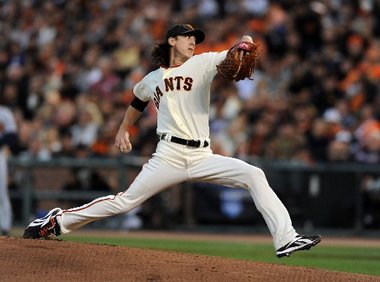
The Giants bounced into the playoffs on Sunday on the strength of some solid pitching, a little bit of here-and-there hitting, and one big fly from a rookie catcher who plays as though he’s had some kind of Cal Ripken Jr poise-transplant. To call Buster Posey “old school” is a misnomer; there weren’t many 23 year-olds like this back then, either. I wouldn’t say that faith is my strong suit as a baseball fan, and my early sense in both of the first two San Diego games was that the Giants would lose. But the final game had a different feeling, and despite a largely average offense, when their pitching has been on it’s really been on. I called Posey’s home run, despite his 0 for 12 mark to that point in the series. “Right here Buster – take him deep,” I said aloud and to myself, watching my small computer screen. Outside of a few profanities, it had been the only thing I’d muttered in three days. I make no predictions moving forward to the playoffs, and those hung up on such things obviously don’t get it. This was the culmination of a 162 game season and the Giants won the West. If you can’t wrap your head around that, then you’re a Yankee fan, and one who misses the point that even their most stirring recent season came in 2001 when they came up short in the World Series.

In a less competitive realm, I took in two movies in recent weeks – Woody Allen’s You Will Meet A Tall Dark Stranger and David Fincher’s The Social Network.  The decision to see both was based largely on positive reviews – specifically David Denby’s for the Allen film. I’ll generally take a chance on most things Woody does, and have no real problem with his tireless insistence on life’s meaninglessness. But I failed to channel Denby’s experience of the film and can’t bring myself to proclaim it “perverse and fascinating.” Much of Allen’s late-life work is reminiscent of George Carlin’s final routines, minus the overt bitterness and served in a slightly more urbane manner. Still, it’s always inspiring to see Josh Brolin portray a dumpy, middle-aged, has-been novelist who can seduce the stunningly beautiful and engaged young woman across the courtyard by explaining that he’s been spying on her through the window.

Social Network was a different deal entirely, and despite my initial resistance to the subject matter I found it to be a quick-moving two hours. While by no means a flattering portrayal of Facebook creator Mark Zuckerberg, I wouldn’t call it a hit piece, either. As the credits rolled, the well put-together dude sitting next to me with his girlfriend remarked “that movie did its job – I wanted to punch that guy in the face.” Curiously, my experience was quite the opposite, and while assuming that much of the content was highly fictionalized, my post-viewing impression of the Zuckerberg character was more favorable than what little I’ve pieced together about the real-life kid billionaire. Maybe if Zuckerberg had the West Wing writer feeding him the same snappy, condescending dialogue, he’d come off as equally unlikable but a bit more defined. In any case, The Social Network’s message that life is unfair is still marginally more palatable if no more reasonable than Woody Allen’s that it has no point at all.

Miller

nagooshedThe filmmaker formerly known as Scott Miller visited me last week, under his current incarnation “Coleman.” He’s explained this decision to push his middle name front and center as an attempt to stand out more in the increasingly Internet-oriented world of independent film making, but it still escapes my limited comprehension. If a guy as personality-laden as Miller has to lean on gimmick to get noticed, what hope could there possibly be for the rest of us? Still, he’s always handled my rockheaded resistance to his evolution with characteristic Midwestern aplomb, and typically diffuses my ill-timed if affectionate barbs with a well-placed “settle down, tough guy ..”

Though he’s currently booked on an indefinite engagement at the Chicago-based Arthur Miller Workshop for Kinetic Sculpture, the success of Scott’s recent New York City program may be a sign of things to come. He prefaced one short work, Bony Orbit, involving a copulating couple juxtaposed with an instructional film on the workings of the human eye with the qualification “well, I think it’s a riot, but we’ll see how it goes ..” This balance between self-contained amusement and an intense desire to connect with a larger audience has been something I’ve long admired in Miller, along with the obvious enjoyment he derives from his work. The trade-off of having to get used to “hey, you’ve reached Coleman” on his outgoing message is indeed small price to pay.


Staten Island Lightning From Brooklyn 9.22.10

Loudmouths

These go to eleven .. – Nigel Tufnel

I was at a Giants game in San Francisco last month, sitting in front of some loudmouth who was maintaining a string of ceaseless discourse for his imprisoned seatmates. “Buster Posey – this kid’s terrific, although you won’t get many long balls out of him ..” Posey proceeded to hit the next pitch out of the park – 410 feet to straight-away center field. It was the greatest shut-up moment since Annie Hall, when Woody Allen pulled Marshall McLuhan from out of frame at a movie theater to silence the pompous academic blowhard in line behind him. “You know nothing of my work .. how you ever got to teach a course in anything is totally amazing.” Of course Posey’s shot did nothing to quiet the guy, and he ranted on obliviously for the rest of the game. At one point I took to refuting his inane proclamations, in a conversational tone and without turning around. My buddy Paul rightly told me to let it go. I was in town for Paul’s wedding where I gave a toast and mentioned that Paul isn’t always “the most effusive guy in the room.” It was another way of saying that he isn’t a loudmouth – but I could have just as easily mentioned that he handles them better than I do.

While I admit openly to not being a fan of loudmouths, it isn’t without qualification. Context is everything, and over-modulation alone does not an idiot make. Anyone who knows me well also knows that I’m capable of boosting the volume on the rare occasion I deem worthy. And yet I’ve been accused of being “quiet” by more than a few. The way I see it, if I have to yell over you to get my point across or my line heard, it isn’t worth it. It’s like attempting to be a better writer by switching to a larger font. But these are just my thoughts, and people who maintain opinion-oriented blogs well in to middle-life probably shouldn’t throw stones.

Generally speaking, I also prefer quiet humor. I’m not talking Steven Wright here (although the guy is quite funny) and ‘quiet’ in and of itself isn’t the point. But then again, neither is Howie Mandel . I was watching Will Ferrell on a Letterman rerun the other night, and realized that I’m almost always ready to laugh when I see this guy. And while he can certainly turn it up a notch (as he did this night with his Harry Caray impersonation) it’s never just for the sake of getting loud. Typically he’s completely understated – with Letterman “deferring” was an appropriate term. And yet he’s funny as hell.

As with all things there are exceptions, and Sam Kinison never would have made it with Bob Newhart’s delivery. But when it comes to loudmouths, humor and exceptions, I defer to Fran Lebowitz’ remarks on dogs. She was arguing against their usefulness (an opinion I do not share) and noted that even some dog-haters will make an exception in the case of the pathologically lonely and the blind. “But I have a solution,” she explained. “Let the lonely lead the blind.” I’m not as clever as Lebowitz, but were I to construct an equally good line relating to loudmouths I would hope that, like her, I’d go with the understated delivery.

Late Greats

Squash Hashanah

I make no claim to being a photographer, but my great-grandfather was one by trade. It seems to me there have been two kinds of memorable pictures taken since the invention of picture-taking: those given much thought prior to execution, and those that came about because some guy had a camera. And just about every guy has a camera these days, outside of self-professed Luddites and some prisoners. The second part of the photography equation used to involve darkness and chemicals, but with the advent of limitless digital storage this necessity is gone. Now, whether it’s an old glass plate or an iPhone snap, it comes down to if anyone does anything with it after. In this sense my father has been as responsible for his grandfather’s notoriety as was the man himself, by virtue of getting his images out there. There are no doubt countless examples (now multiplying daily and exponentially) of magnificent photographs that nobody will ever see. But this isn’t unusual, and can be said for a lot of things.

The three snaps above, while not technically impressive, are relevant because they were taken with my new cell phone in late August and early September. Sequentially, they are of California, Nevada (Lake Tahoe), and New York (Brooklyn). If part of who we are can be ascertained from where we’ve been, then this new technology is of some worth even if we’re just flicking through our phone with a finger. Don’t ask me to break down what it’s worth though; I personally think it’s an example of a little too much all moving a little too fast.

Mad Good

I’m just going to put this one out there. While I’m still squarely in the camp of The Sopranos, last Sunday’s episode of Mad Men – “The Suitcase” – was as good as anything I’ve seen on television in a very long time. Much mention was made of the strong writing for female characters on HBO’s mob series, but I’d now officially take the waspy, buttoned-down, sexually dominant and functionally psychotic Peggy Olson over former (and pre-Carmela) First Lady Rosie Aprile in a twelve-round contest any day. If TV is still the most prominent marker of popular culture, Feminism has stepped to plate in a manner that makes Gloria Steinem look like Morganna The Kissing Bandit. Interestingly, it’s done so in a 1960s-based series created in the 2000’s. Of course the two shows share many common ties, but that’s another matter.

Speaking of twelve-rounders, the ’65 Ali-Liston fight provided appropriate backdrop for this episode, and one can imagine how the writers – and in this specific case creator Matthew Weiner – began with this simple premise and expanded on it. “Suitcase” (and this is quite literally what Don Draper has become – a case in a suit) was as subtle and nuanced as an Ali jab and as punishing as a Liston uppercut. In the end it was Draper filling the Liston position, looking up from the mat at Peggy Olson’s Ali and offering an uncharacteristically and strongly feminine hand atop hers as appreciative gesture. As brilliantly as this played out, the show – much like The Sopranos – never settles for simple or contrived resolution. Olson may have been the last woman standing, but nobody cleans up from a fight like Draper.

There were at least another dozen outstanding points worth mention. The underlying, under-played, and almost completely unstated sexual tension hung over the episode like a looming thunderhead. The all-trumping, and again Soprano-reminiscent theme of maternal power (in this case Peggy’s over Don) was executed beautifully. And the show continues to portray alcoholism in all of its nuanced, falsely seductive, and retching glory. To cap it all off, we learn in this episode that Bertram Cooper quite literally has no balls – at the same time as the plot is deftly unveiling that none are necessary to dish out a serious ass-kicking. As good as the acting on this show has been, the players would be well-advised to slip a little something extra in the writers’ pockets come this Christmas, if only for this latest effort.

Downtime Googling

God it’s such a drag when you’re living in the past – Petty

I received an email from my buddy Denis Munro last week, commenting on a piece I’d written some time ago. Denis had a long and successful career as head of city planning in Perth, Scotland, and now keeps his feet wet with consulting work several days a week. It was from this office that he’d written, confessing apologetically that he was reading my stuff within the context of downtime googling. He was going through my entire site systematically and comprehensively, reading each post date by date. While I’m not entirely devoid of self-promotional instinct, this seemed an act of penance better suited for the Lockerbie Bomber. He also commented on the pressures that might arise trying to write regularly to “meet reader expectations.” I didn’t bother to explain that those expectations could be easily assuaged with a CC’d email to four; the other part of his point was relevant. I hadn’t felt much like writing lately.

Why write, after all? This question came up yesterday while on the phone with my other buddy Scott (Coleman) Miller, who now lives in Chicago. He’d been out with friends recently, and one woman told him that he needed to write a book. “Your stories are so great,” she reasoned. I asked which stories she was referencing and he mentioned one he’d told her about serving jury duty in San Francisco. One of the attorneys was questioning him as a potential juror and asked if he’d ever been mugged. When Miller answered in the affirmative the guy asked when the incident had taken place. “I’m not sure of the exact date,” he told him, “but it was the night Redd Foxx died.” I had to agree that this was book-worthy material, but it’s so much easier delivered as cocktail party banter, and particularly if you’re a guy like Scott. His ability to interject during tepid conversation and boost the volume from three to eight is unrivaled. Why bother with sitting down at the keyboard and coming up with a clever Sanford and Son intro when you can just spit it out? And, in a nutshell, this covers my frequent aversion to writing – too much pretense and assumption when a conversational volume boost could render it over and done with.

So it was I’d skipped over several writing ideas recently for lack of motivational oomph. I thought of piecing something together about the Tom Petty show I’d seen at Madison Square Garden; how his new CD is better than anything he’s done in years and has been largely misinterpreted. I was going to write something about more “sophisticated” music fans who have dissed Petty over the years because his commercial success and ability to craft intelligent but infectiously catchy singles offends their priggish David Byrne sensibilities. But I refrained, and probably wisely. At another juncture, walking through Manhattan, I saw the large, two-story inflatable rat that NYC labor unions erect in front of non-complying businesses. I considered some opening sentences for a post on when one actually becomes a New Yorker – the subtle psychological shifts and transitions from novel to familiar. But my brain soon tired and I let go of the idea, letting things settle while staring up at the giant, 15-foot rodent balloon.

A few days on I was in my Brooklyn hood getting some keys made for my landlord who is renting her place back from me this month. This was probably my fourth visit to this particular locksmith – the landlord has returned on several occasions and tends to lose the keys after each visit. I joked with the guy that it was good business for him and he corrected me. “Actually, I don’t pay the rent cutting keys.” This led to an extended conversation as he carved away at the blanks about how, exactly, he did pay the rent. His bread and butter is house calls, but it turns out that even his business is being usurped by the digital age and house keys are going the way of car keys and an electronic swipe. The machinery necessary to replace these new devices is licensed at an exorbitant rate and requires a shop owner to buy “tokens” with each use – a practice this guy said would put him out of business. I sympathized, explaining that my family was in the film business and digital technology had greatly affected our customer base and the way we invested.

He finished the last key and told me it would be eight dollars and forty-five cents. “My customer base is largely gone,” he said, making change. “When people lock themselves out now, they use one of these things to find a locksmith ..” He mimed gripping an iPhone and flicking through the Internet choices with his finger. “Guess we’re getting old,” I told him, mostly because it seemed like the kind of thing I was supposed to say at that point in the conversation. He smiled knowingly, apparently pleased, and I left the shop. My own smartphone was arriving Fed Ex that afternoon.